
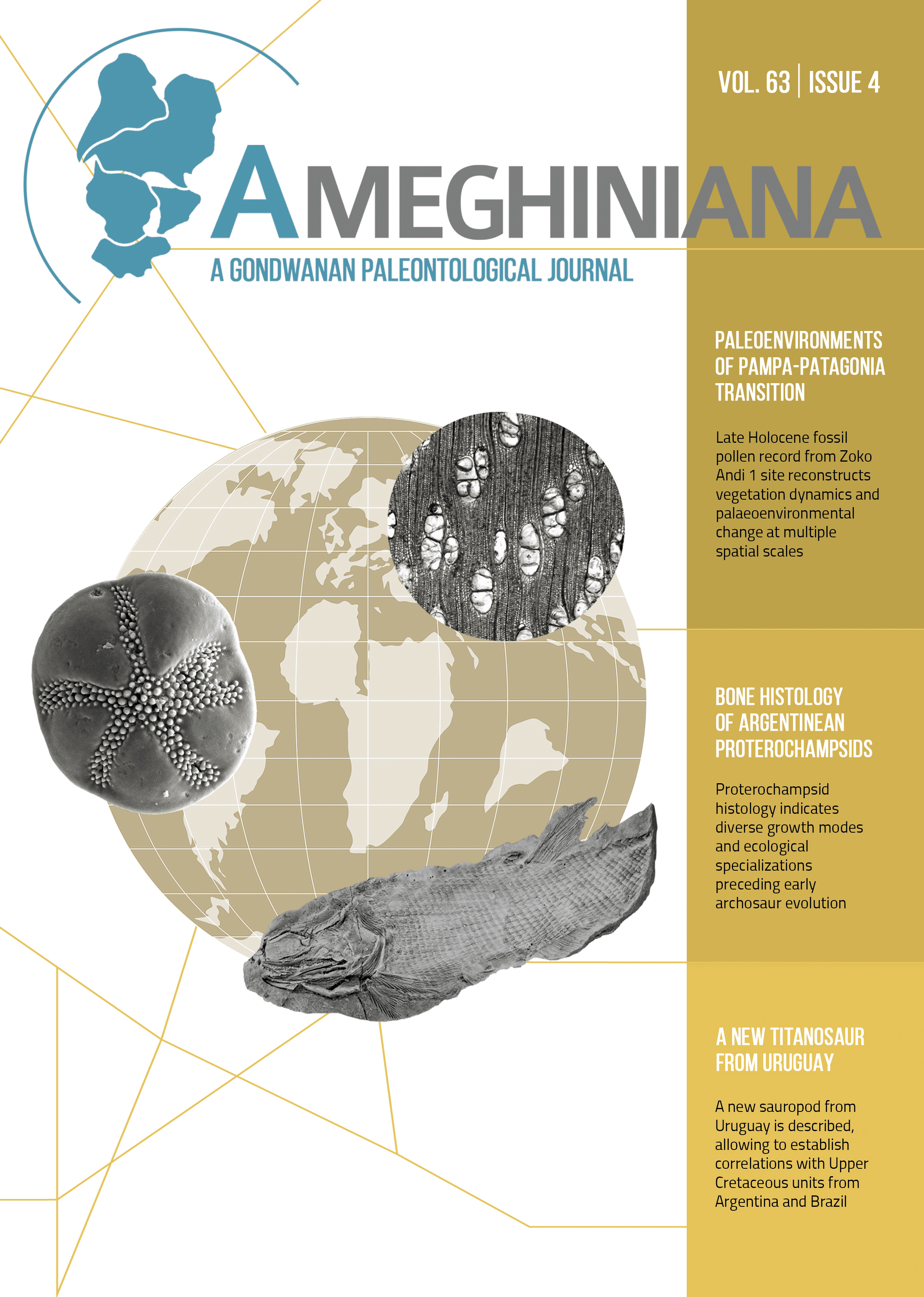
Advances on the paleobiology of Upper Triassic Argentinean Proterochampsidae (Archosauriformes): growth dynamics, intraspecific variation, and palaeoecology
DOI:
https://doi.org/10.5710/AMGH.08.09.2026.3677Keywords:
Argentina, bone histology, Chanaresuchus, growth rate, lyfestyle, Proterochampsa, Triassic, TropidosuchusAbstract
Proterochampsids were small to medium-sized carnivorous quadrupedal archosauriforms from the Middle–Upper Triassic of
America. In Argentina, they are distributed in the Ischigualasto-Villa Unión Basin. Here, we describe the bone histology of Argentinean proterochampsids Proterochampsa barrionuevoi PVSJ 606 (humerus), Tropidosuchus romeri PVL 4602 (femur), Gualosuchus reigi PVL 4576 (humerus, femur and tibia) and Chanaresuchus bonapartei PVL 4575 (humerus and tibia) and PVL 6244 (humerus, femur, dorsal rib) to infer growth dynamics (using qualitative and quantitative approaches), inter and intraspecific variation and lifestyle (using statistical models). Proterochampsa and Tropidosuchus reached moderate–fast growth, based on woven-fibred bone tissue and radial-longitudinal vascularisation, although Proterochampsa exhibits an external fundamental system, indicating growth cessation. Gualosuchus displays a fibrolamellar complex highly vascularised during early stages of its ontogeny, indicative of rapid growth. Individuals of Chanaresuchus show disparate growth strategies, characterized by parallel-fibred bone tissue alone, or in association with patches of woven-fibred bone, together with moderate to high levels of vascularisation. Therefore, proterochampsids present a notable diversification in their growth strategies, which is reflected between species and within individuals (especially marked in Chanaresuchus). Quantitative analyses indicate irregular growth rates, similar to those of extant crocodiles. Analyses of the lifestyle suggest a differentiation in the divergence of Proterochampsidae subfamilies, with Proterochampsinae (Proterochampsa) as amphibious/aquatic and Rhadinosuchinae (Chanaresuchus, Gualosuchus and Tropidosuchus) as terrestrial. These findings provide new insights into the palaeobiology and ecological diversification of Proterochampsidae, shedding light on the evolutionary pathways that preceded the emergence of crown-group Archosauria.
Downloads
Published
Issue
Section
License
Authors publishing in Ameghiniana have the option of making their article freely available online. Authors opting for the Open Access must pay a fee of $300 (US dollars) to cover article-processing costs and to ensure the article is made open access. Please contact the Production Team after the acceptance of your manuscript if you are interested in making your article Open Access. This option implies by default a license Creative Commons Attribution Non-Commercial-NoDerivs License (CC BY NC ND). If your funding institution requires a different licensing option please communicate this to the Production Team after the acceptance of your manusctipt.


