REASSESSING THE HYPERDIVERSE DINOMYID (RODENTIA, CAVIOMORPHA) ASSEMBLAGE FROM THE LATE MIOCENE ITUZAINGÓ FORMATION (ENTRE RÍOS PROVINCE, ARGENTINA)
DOI:
https://doi.org/10.5710/AMGH.07.12.2025.3663Keywords:
Neogene, South America, Mammals, SystematicsAbstract
The Late Miocene Ituzaingó Formation (northeastern Argentina) has the most diverse caviomorph rodent assemblage of South
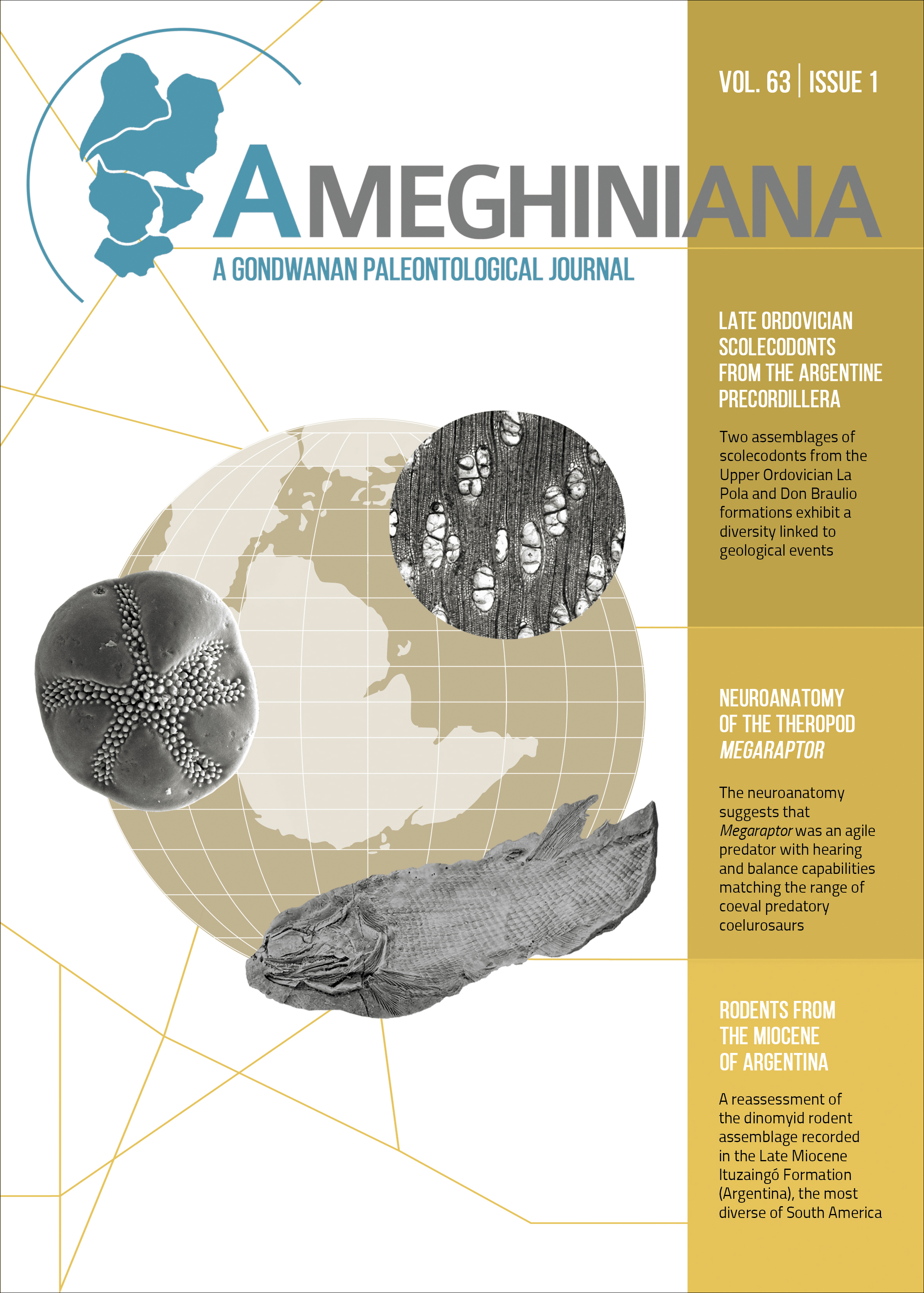
America. The family Dinomyidae, with a single extant species (Dinomys branickii), also has its highest taxonomic diversity in this unit: 18 genera and 27 species, many of doubtful status. A reexamination of the holotypes of several species and other published and unpublished material leads to the following conclusions: “Tetrastylomys castellanosi” should be considered Tetrastylus sp.; the type series of “Eumegamys contortus” pertains to Carlesia pendolai and Rusconia crassidens; “Pentastylomys seriei” is a junior synonym Gyriabrus holmbergi; “Protomegamys” coligatus should be included in the genus Gyriabrus; “Doellomys parcus” is a junior synonym of Gyriabrus coligatus (new combination); “Diaphoromys compressidens” and “Eumegamys dubius” are a junior synonyms of Diaphoromys gamayensis; “Briaromys trouessartianus” is a nomen dubium; “Megamys racedi” and “Megamys depressidens” are nomina vana; and Pseudosigmomys paranensis, Telodontomys compressidens, Diaphoromys mesopotamicus, Eumegamys scalabrinianus, and Rusconia crassidens are valid. In addition, Arazamys castiglionii is recognized for the first time in Argentina. With this revision, the taxonomic diversity of Dinomyidae from the Ituzaingó Formation is reduced to 13 genera and 19 species. Nevertheless, it remains higher than other coeval units of South America, like the Urumaco Formation in Venezuela (five genera), Solimões Formation in Brazil (nine genera), Camacho Formation in Uruguay (four genera), and Cerro Azul Formation in Central Argentina (four genera).
Downloads
Published
Issue
Section
License
Authors publishing in Ameghiniana have the option of making their article freely available online. Authors opting for the Open Access must pay a fee of $300 (US dollars) to cover article-processing costs and to ensure the article is made open access. Please contact the Production Team after the acceptance of your manuscript if you are interested in making your article Open Access. This option implies by default a license Creative Commons Attribution Non-Commercial-NoDerivs License (CC BY NC ND). If your funding institution requires a different licensing option please communicate this to the Production Team after the acceptance of your manusctipt.


