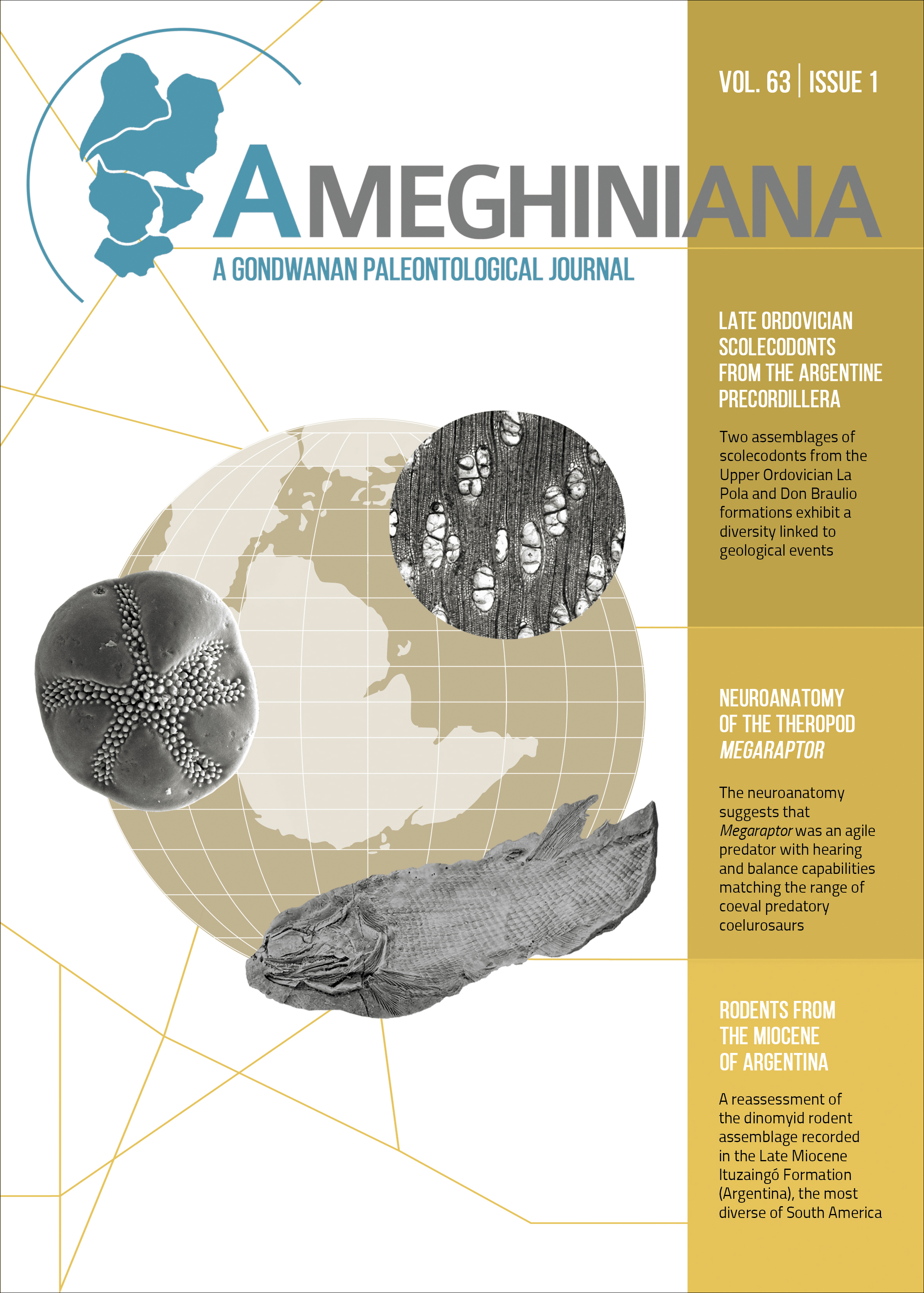
NOVEL INFORMATION ON THE BRAINCASE OF MEGARAPTOR NAMUNHUAIQUII (DINOSAURIA: THEROPODA) USING X-RAY TOMOGRAPHY: PNEUMATICITY, PALEONEUROLOGY, AND THEIR PALEOBIOLOGICAL IMPLICATIONS
DOI:
https://doi.org/10.5710/AMGH.18.10.2025.3657Keywords:
Megaraptoridae, Neuroanatomy, Sense Biology, Hearing, Cretaceous, Hunting HabitsAbstract
X-ray computed microtomography was used to segment and re-describe the braincase of the juvenile specimen of Megaraptor
namunhuaiquii, providing novel anatomical endocranial information. The reconstructed soft tissues include the brain, cranial nerves, blood vessels, inner ear, and pneumatic sinuses. Some structures of the braincase anatomy were re-interpreted, and the endocranial anatomy was compared with that of Murusraptor barrosaensis (the only other megaraptoran with studied endocranial anatomy) and more derived theropods. The braincase and the brain exhibit a mosaic of primitive and derived characters that support the previously proposed close relation of Megaraptor with basal coelurosaurian theropods (including basal Tyrannosauroidea). A high degree of braincase pneumaticity, a high mean range of hearing, and a relatively large floccular lobe of the cerebellum are features that suggest that Megaraptor was an agile bipedal predator compared to non-coelurosaur coeval theropods, such as abelisaurids. Its cognitive and sensorial abilities may have allowed Megaraptor to compete with coelurosaurs (unenlagiines?) or at least reach many of their hunting capabilities.
Downloads
Published
Issue
Section
License
Authors publishing in Ameghiniana have the option of making their article freely available online. Authors opting for the Open Access must pay a fee of $300 (US dollars) to cover article-processing costs and to ensure the article is made open access. Please contact the Production Team after the acceptance of your manuscript if you are interested in making your article Open Access. This option implies by default a license Creative Commons Attribution Non-Commercial-NoDerivs License (CC BY NC ND). If your funding institution requires a different licensing option please communicate this to the Production Team after the acceptance of your manusctipt.


