About the Journal
Ameghiniana is a bimonthly, peer-reviewed journal that publishes original contributions across all disciplines of Paleontology, with a special focus on the paleontology of Gondwana and the biotic history of the Southern Hemisphere. Published yearly since 1957, it has become one of the main paleontological publications from Latin America. Ameghiniana has recently broadened its editorial team, reorganized its production process, and increased its frequency to bimonthly, resulting in a significant decrease in turnaround time.
2024 Journal Impact Factor (Clarivate Analytics, updated July 2025): 1,5
Scimago Journal & Country Rank, SJR 0.536, Q2 (updated May 2026)
Scopus Citescore, Citescore 2024 = 2.6 (updated May 2026)
Average time from submission to publication online: 3.3 months (updated October 2023)
Average time from submission to final publication: 7.2 months (updated July 2024)
Publication Frequency: 6 issues per year
Get your access online to Ameghiniana now through the following options:
1) You may become a member of the Asociación Paleontológica Argentina to get access to the entire history of Ameghiniana in PDF, from volume 1 of 1957 to the one most recently published. Check fees and pay with a credit card online. Individual PDFs are also on sale (25 US$ each; please contact the editor-in-chief).
2) You can access Ameghiniana (2010-present) via a BIOONE subscription:
https://bioone.org/journals/ameghiniana

Its contents are indexed in most international databases, including Clarivate Web of Science Core Collection Citation Index Expanded, Scopus, Scimago, Biological Abstracts, Zoological Record, Current Contents (Physical, Chemical & Earth Sciences), Essential Science Indicators, Geological Abstracts, Bibliography and Index of Geology, Latindex, Gushengwuxue Wenzhai, Pascal, Referativnyi Zhurnal, and Research Alert.
Articles include the following disciplines: Systematic Paleontology, Phylogeny, Paleobiology, Paleoecology, Paleobiogeography, Biostratigraphy, Ichnology and Taphonomy. Studies on stratigraphy, paleoenvironmental reconstructions, and extant material will also be included when the conclusions have significant paleontological implications. Review papers are also considered if they focus on topics within the journal's scope. Please contact a member of the Editorial Board if you are interested in submitting a Review Paper.
_11.25_.33_.png)

Current Issue
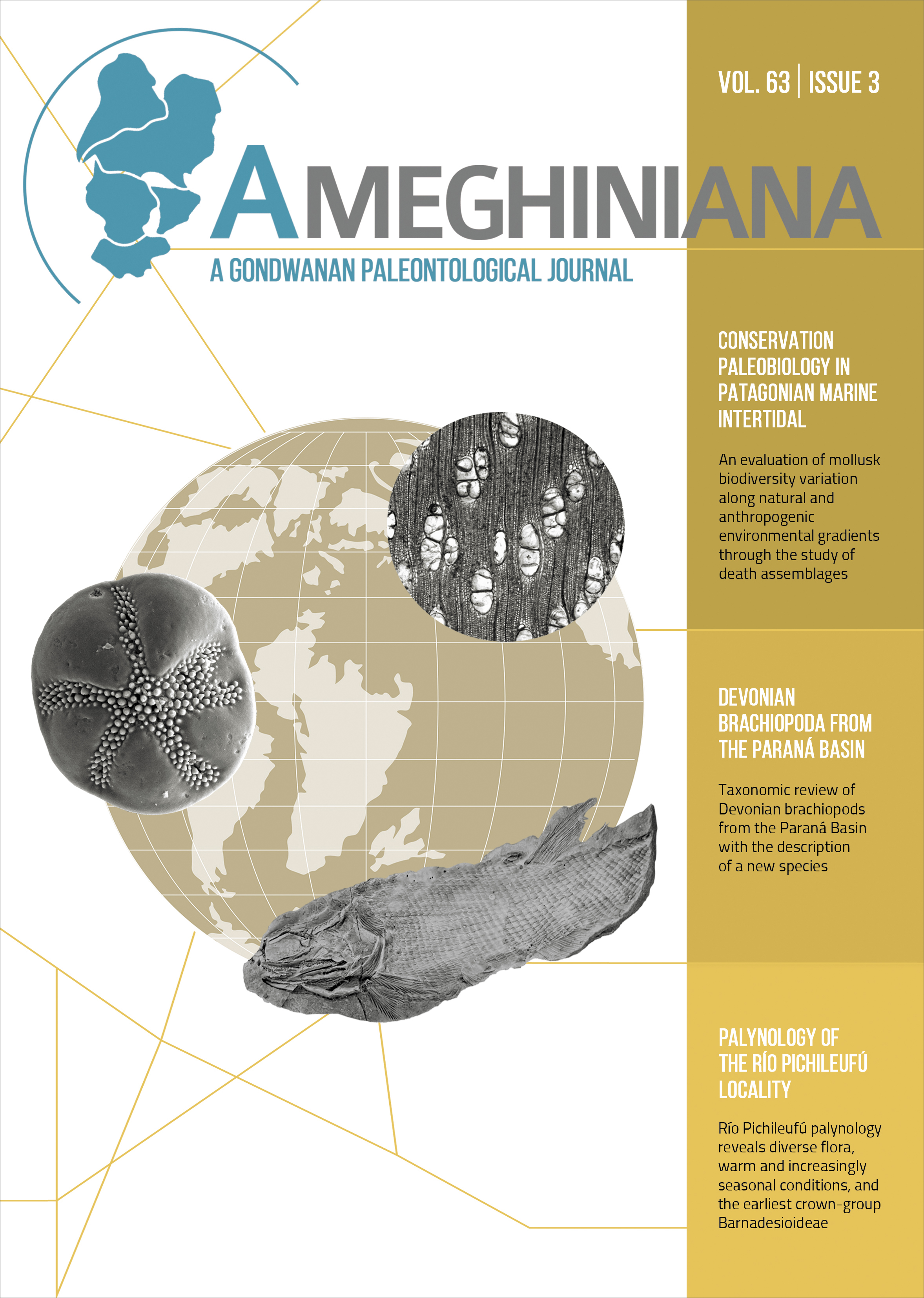
Vol. 63 No. 3 (2026)
HIGHLIGHTS
- CONSERVATION PALEOBIOLOGY IN PATAGONIAN MARINE INTERTIDAL
An evaluation of mollusk biodiversity variation along natural and anthropogenic environmental gradients through the study of death assemblages.
- DEVONIAN BRACHIOPODA FROM THE PARANÁ BASIN
Taxonomic review of Devonian brachiopods from the Paraná Basin with the description of a new species.
- PALYNOLOGY OF THE RÍO PICHILEUFÚ LOCALITY
Río Pichileufú palynology reveals diverse flora, warm and increasingly seasonal conditions, and the earliest crown-group Barnadesioideae.
Published:
2026-09-19


